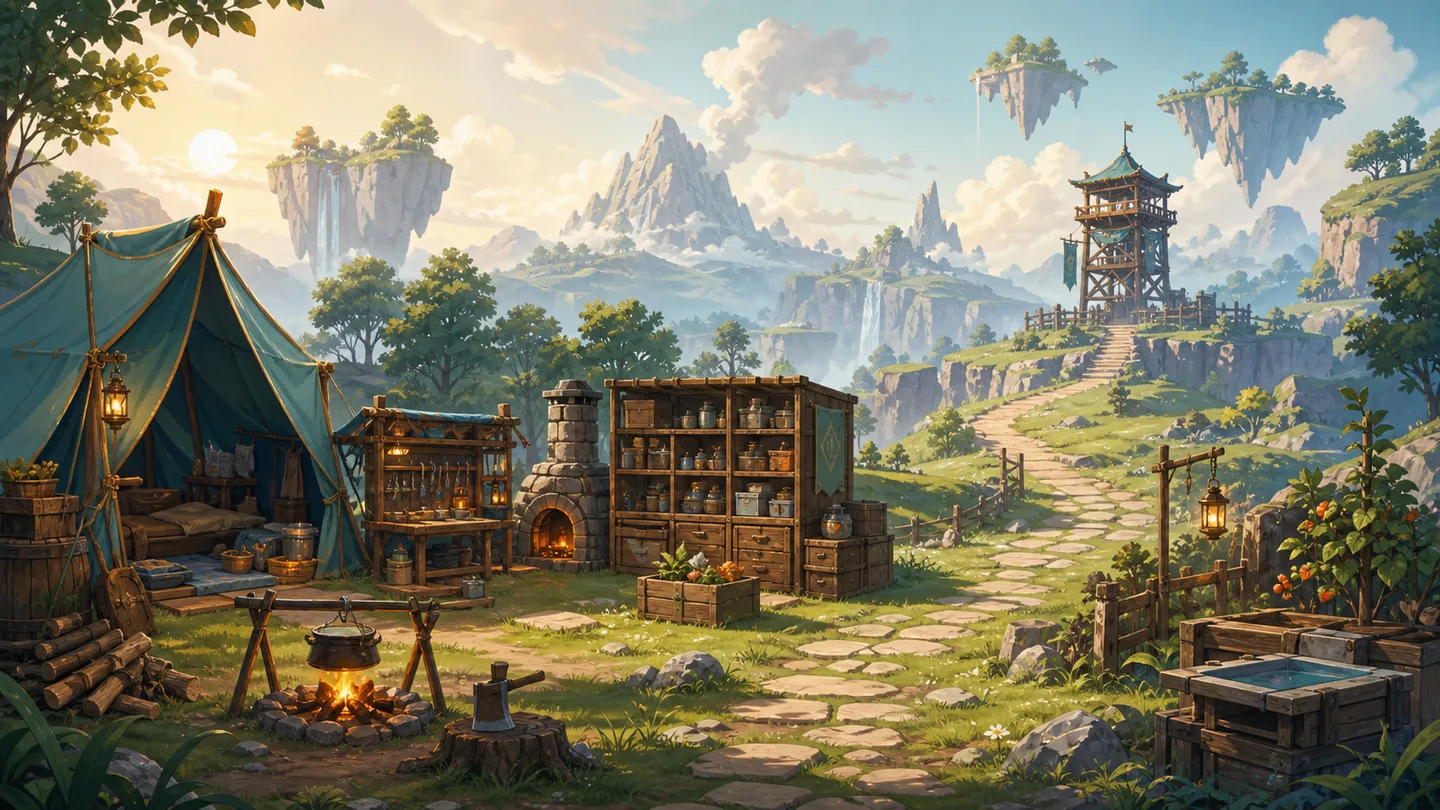
Your first session priorities
Version 1.0 reworks mission flow, capture progression, Pal skills, Work Suitability, bases, raids, and exploration. Use the main mission as your navigation spine instead of following an Early Access speed route.
The goal of the first session is not maximum level. It is a stable loop: gather, craft, capture, assign work, store resources, travel safely, and return with enough information to choose the next upgrade.
Beginner roadmap
| Stage | Main objective | Useful actions | Avoid for now |
|---|---|---|---|
| First 10 minutes | Learn the current mission and controls | Gather basic materials; check settings; capture several early Pals | Skipping prompts because an old route looks familiar |
| 10–30 minutes | Create a working starter base | Place storage near crafting; leave Pal paths open; assign varied work | Treating the first base as permanent |
| 30–60 minutes | Stabilize food, equipment, and travel | Follow missions; inspect Pal skills; activate useful map guidance | Spending rare items on an untested build |
| Next sessions | Expand only when a need is clear | Add production, defenses, exploration gear, and backups | Copying tier lists or best-location claims without verification |
Build a starter base that teaches you the game
- Choose accessible ground with room to walk; this is a learning base, not a Best Base Location claim.
- Put frequently used storage close to the stations that consume those materials.
- Leave open paths around beds, food, storage, and production so Base Pals can reach work.
- Assign a mixed group and inspect Work Suitability instead of filling every slot with one job type.
- Check food supply and stalled work before adding more stations.
- Keep the layout easy to move because Aquatic Construction and later production needs may change your plans.
Capture and Pal-management priorities
Capture Bonuses now require five captures rather than twelve, while the maximum condensation requirement is lower than in Early Access. These official changes make repeated captures useful, but they do not make every nearby Pal equally valuable for your team.
Build variety first: one dependable combat option, useful movement or Partner Skills, and several work roles. Re-read descriptions because more than 200 Partner Skills and almost all Active Skills were reviewed for Version 1.0.
- Check elements, Active Skills, Partner Skills, and Work Suitability before dismissing a duplicate.
- Keep useful workers even if they are not part of the current combat party.
- Delay heavy condensation, Awakening, Mutation, or breeding investments until the resource cost is understood.
- Best starter Pal rankings still need in-game verification.
Technology and resource decisions
Unlock technology that removes an immediate bottleneck: food, storage, gathering, crafting, survival, travel, or defense. A long list of unlocked stations is not useful when the base cannot supply or operate them.
Keep a reserve of basic materials and label rare resources before experimenting. Version 1.0 adds new ores, equipment, accessories, structures, and progression systems, so old spending priorities should not be treated as current by default.
Exploration habits that prevent wasted trips
- Follow the main mission and use watchtowers to reveal nearby map areas and unlock fast travel.
- Carry food, basic repair or replacement supplies, capture items, and free inventory space.
- Mark or remember caves, cliffs, settlements, resources, and return routes before pushing farther.
- Deposit valuable materials before testing unfamiliar high-risk content.
- Do not rush Sunreach or the World Tree based on an unverified shortcut. Needs in-game verification.
Solo or multiplayer?
| Format | Best for | Before investing | Main risk |
|---|---|---|---|
| Solo | Learning systems at your own pace | Choose a backed-up world and comfortable settings | No shared help when a route or base fails |
| Small co-op group | Shared exploration and divided base jobs | Agree on host, uptime, progression pace, and shared storage | Players progressing at different speeds |
| Dedicated server | Persistent group worlds | Confirm backups, version, settings, MOD policy, and rollback rules | Host load, MOD problems, or unclear permissions |
Before ending the first session
- Confirm the current mission objective and one next-session goal.
- Check food, storage, production queues, and Pal assignments.
- Store rare materials instead of carrying them into an unknown fight.
- For multiplayer, verify saving and reconnect behavior.
- Back up an important world before adding MODs or making irreversible changes.
What not to trust yet
The official v1.0 changelog is available, but exact stat priorities, best Pals, best base locations, fastest routes, and definitive endgame recommendations still need player testing.
Use player-tested advice only when it explains the build, platform, settings, route, and evidence. A claim that simply says best, fastest, or mandatory is not enough.
Source note
This beginner guide uses Pocketpair's official Palworld v1.0 Steam changelog for mission, map, Pal, capture, base, raid, progression, multiplayer, and MOD facts. Route timing, rankings, permanent base decisions, and optimized builds remain marked for player verification.